
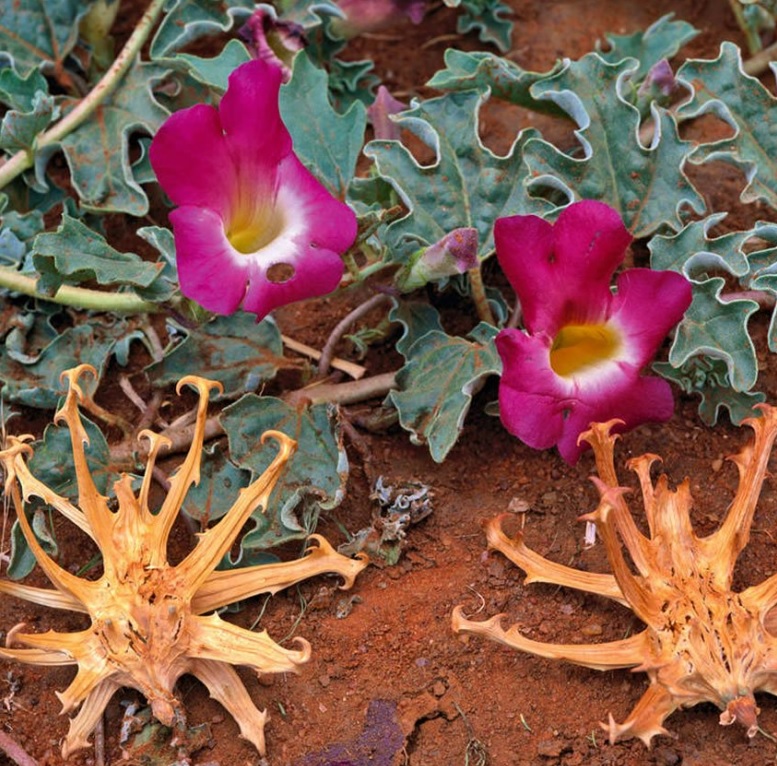
Harpagophytum procumbens
Harpagophytum procumbens, commonly known as Devil’s Claw, is a medicinal plant native to the arid regions of southern Africa. Traditionally used by indigenous communities for a wide range of ailments, it gained prominence in European herbal medicine in the early 20th century. The roots and tubers of this plant contain active compounds—particularly iridoid glycosides like harpagoside—that have been shown to possess potent anti-inflammatory, analgesic, and antirheumatic properties.
Extracts of Harpagophytum, including those prepared through oil infusion, have demonstrated the ability to reduce swelling and stiffness associated with inflamed joints and muscles, making it a valuable natural option for managing musculoskeletal pain. We use oil extraction methods and incorporate Harpagophytum into our therapeutic oils and salves, alongside other synergistic botanicals, to potentiate healing and enhance anti-inflammatory effects. Today, Devil’s Claw is widely recognized in complementary medicine, especially in Germany and France, for its role in relieving arthritis, back pain, and other inflammatory conditions.

Short Monograph
| Other names: | Devils Claw, Devil’s Claw Root, Garra del Diablo, Grapple Plant, Griffe du Diable, Harpagophyti Radix, Harpagophytum, Harpagophytum procumbens, Harpagophytum zeyheri, Racine de Griffe du Diable, Racine de Windhoek, Teufelskrallenwurzel, Uncaria procumbens, Wood Spider. |
| Characteristics: | Harpagophytum procumbens, also known as Devil’s Claw named for the tiny hooks on its fruit, grapple plant and is native to southern Africa, where it’s been used traditionally for many conditions |
| Therapeutic use: | Anti-inflammatory and analgesic (pain-relieving) in the treatment of arthritis and related conditions. To manage back pain and inflammation. Topically for skin problems such as sores and boils. Traditionally: fevers, liver & kidney problems, skin problems. Introduced to Europe in the early 1900s, dried roots were used to restore appetite, relieve heartburn, pain, and inflammation. Current widely used in Germany and France for inflammation and pain relief |
| Evidence/studies: | Anti-inflammatory, antibacterial, antifungal, antiviral, and anticancer properties. Scientific research suggests that Devil’s claw offers superior benefits compared to non-steroidal anti-inflammatory drugs (NSAIDs), making it a preferable alternative treatment. |
| Parts used: | Roots; tubers |
| Constituents: | Contains iridoid glycosides, particularly harpagoside that have strong anti-inflammatory effects. |
| Actions: | Anti-inflammatory – Inhibits pro-inflammatory cytokines and COX-2 expression. Analgesic – Often used for musculoskeletal pain, especially lower back pain and arthritis. Anti-rheumatic – Supports joint health and mobility. Bitter tonic – Stimulates digestion and appetite via bitter principles. Choleretic – Enhances bile production, supporting liver and gallbladder function. |
| Indications: | Osteoarthritis: Reduces pain and improves physical functioning Back and Neck Pain: Provides relief and reduces need for painkillers Other Uses: Suggested for upset stomach, headaches, allergies, and fever Topical Use: Applied to heal skin lesions, sores, and ulcers. |
| Evidence/Studies: | |
| Contraindications: | Peptic ulcers Gallstones (due to choleretic activity) Pregnancy (limited safety data) Use with anticoagulants or antiplatelet drugs may increase bleeding risk (theoretical) |
| Adverse effects: | Low toxicity profile when used appropriately. No major toxic effects have been reported in therapeutic doses. |
| Toxicity: | Generally well tolerated, but potential mild GI symptoms may include: Upset stomach Diarrhea Nausea Headache (occasionally) May worsen ulcers or GERD due to its bitter compounds. |
| Interactions: | By mouth: no known interactions with herbs and supplements.Prescription medication:Medications changed by the liver (Cytochrome P450 substrates); Warfarin (Coumadin); H2-blockers & Proton pump inhibitors used to decrease stomach acid; |
| Additional info: | For external use only, to not be used on broken skin. Caution is advised during pregnancy and breastfeeding and also on a child’s skin due to a lack of safety studies. |
| Daily Therapeutic Dose: | By mouth: Devil’s claw has most often been used by adults in doses of 108-2400 mg daily for 8-12 weeks. |
Evidence/Studies
- Osteoarthritis:
A 4-month randomized, double-blind study compared Harpagophytum (2,610 mg/day) to diacerein (100 mg/day) in patients with hip or knee osteoarthritis. Both groups showed significant symptom improvement, but Harpagophytum had fewer adverse effects and reduced reliance on NSAIDs.
Source: Chrubasik et al., 2001, Phytomedicine. - Low Back Pain:
A 2007 systematic review concluded that aqueous extracts standardized to 50–100 mg of harpagoside per day are moderately effective for chronic low back pain, with efficacy comparable to some COX-2 inhibitors.
Source: Gagnier et al., 2007, Spine Journal. - Muscle Stiffness & Pain:
In a placebo-controlled RCT, 960 mg/day of extract LI 174 improved muscle stiffness and vascular response over 4 weeks.
Source: Wegener & Lupke, 2003, Phytomedicine. - Mechanism of Action:
Recent in vitro data suggests that Harpagophytum activates CB2 receptors in osteoarthritic synoviocytes, reduces cAMP, inhibits MAPK pathways, and suppresses MMP-13—supporting its anti-inflammatory effects through endocannabinoid modulation.
Source: Paterniti et al., 2022, Pharmaceuticals.
Featured image(s) credit to:
Nontobeko Mncwangi, Weiyang Chen, Ilze Vermaak, Alvaro M. Viljoen, Nigel Gericke,
Devil’s Claw—A review of the ethnobotany, phytochemistry and biological activity of Harpagophytum procumbens,
Journal of Ethnopharmacology, Volume 143, Issue 3, 2012, Pages 755-771, ISSN 0378-8741,
https://doi.org/10.1016/j.jep.2012.08.013. (https://www.sciencedirect.com/science/article/pii/S0378874112005387)
Additional references:
Gxaba N, Manganyi MC. The Fight against Infection and Pain: Devil’s Claw (Harpagophytum procumbens) a Rich Source of Anti-Inflammatory Activity: 2011-2022. Molecules. 2022 Jun 6;27(11):3637. doi: 10.3390/molecules27113637. PMID: 35684573; PMCID: PMC9182060.
Abdelouahab N, Heard C. Effect of the major glycosides of Harpagophytum procumbens (Devil’s Claw) on epidermal cyclooxygenase-2 (COX-2) in vitro. J Nat Prod. 2008 May;71(5):746-9.
Baghdikian B, Lanhers M, Fleurentin J, et al. An analytical study, anti-inflammatory and analgesic effects of Harpagophytum procumbens and Harpagophytum zeyheri. Planta Med. 1997;63:171-176.
Brendler T, Gruenwald J, Ulbricht C, Basch E; Natural Standard Research Collaboration. Devil’s Claw (Harpagophytum procumbens DC): an evidence-based systematic review by the Natural Standard Research Collaboration. J Herb Pharmacother. 2006;6(1):89-126.
Brien S, Lewith GT, McGregor G. Devil’s Claw (Harpagophytum procumbens) as a Treatment for Osteoarthritis: A Review of Efficacy and Safety. J Altern Complement Med. 2006;12(10):981-93.
Cameron M, Gagnier JJ, Little CV, Parsons TJ, Blümle A, Chrubasik S. Evidence of effectiveness of herbal medicinal products in the treatment of arthritis. Part I: Osteoarthritis. Phytother Res. 2009 Nov;23(11):1497-515. Review.
Chantre P, Cappelaere A, Leblan D, Guedon D, Vandermander J, Fournie B. Efficacy and tolerance of Harpagophytum procumbens versus diacerhein in treatment of osteoarthritis. Phytomedicine. 2000;7(3):177-83.
Chrubasik S, Junck H, Breitschwerdt H, Conradt C, Zappe H. Effectiveness of Harpagophytum extract WS 1531 in the treatment of exacerbation of low back pain: a randomized, placebo-controlled, double-blind study. Eur J Anaesthesiol. 1999;16(2):118-129.
Chrubasik S, Sporer F, Dillmann-Marschner R, Friedmann A, Wink M. Physiochemical properties of harpagoside and its in vitro release from Harpagophytum procumbens extract tablets. Phytomedicine. 2000;6(6):469-473.
Chrubasik S, Pollak S, Black A. Effectiveness of devil’s claw for osteoarthritis. Rheumatology (Oxford). 2002;41(11):1332-3.
Chrubasik S. [Devil’s claw extract as an example of the effectiveness of herbal analgesics]. Orthopade. 2004;33(7):804-8.
Conrozier T, Mathieu P, Bonjean M, Marc JF, Renevier JL, Balblanc JC. A complex of three natural anti-inflammatory agents provides relief of osteoarthritis pain. Altern Ther Health Med. 2014;20 Suppl 1:32-7.
Denner SS. A review of the efficacy and safety of devil’s claw for pain associated with degenerative musculoskeletal diseases, rheumatoid, and osteoarthritis. Holist Nurs Pract. 2007;21(4):203-7.
Ernst E, Chrubasik S. Phyto anti-inflammatories. A systematic review of randomized, placebo-controlled, double-blind trials. Rheum Dis Clin North Am. 2000;26(1):13-27.
Gagnier JJ, van Tulder MW, Berman B, Bombardier C. Herbal medicine for low back pain: a Cochrane review. Spine. 2007;32(1):82-92.
Gobel H, Heinze A, Ingwersen M, Niederberger U, Gerber D. Effects of Harpagophytum procumbens LI 174 (devil’s claw) on sensory, motor und vascular muscle reagibility in the treatment of unspecific back pain. [German] Schmerz. 2001;15(1):10-18.
Grant L, McBean DE, Fyfe L, Warnock AM. A review of the biological and potential therapeutic actions of Harpagophytum procumbens. Phytother Res. 2007;21(3):199-209.
Gregory P, Sperry M, Friedman Wilson A. Dietary supplements for osteoarthritis. Am Fam Phys. 2008;77(2):177-84.
Heck AM, DeWitt BA, Lukes AL. Potential interactions between alternative therapies and warfarin. Am J Health Syst Pharm. 2000;57(13):1221-7.
Hostanska K, Melzer J, Rostock M, Suter A, Saller R. Alteration of anti-inflammatory activity of Harpagophytum procumbens (devil’s claw) extract after external metabolic activation with S9 mix. J Pharm Pharmacol. 2014;66(11):1606-14.
Izzo AA, Di Carlo G, Borrelli F, Ernst E. Cardiovascular pharmacotherapy and herbal medicines: the risk of drug interaction. Int J Cardiol. 2005;98(1):1-14.
Lanhers MC, Fleurentin J, Mortier F, Vinche A, Younos C. Anti-inflammatory and analgesic effects of an aqueous extract of Harpagophytum procumbens. Planta Med. 1992;58:117-123.
Laudahn D, Walper A. Efficacy and tolerance of Harpagophytum extract LI 174 in patients with chronic non-radicular back pain. Phytother Res. 2001;15(7):621-4.
Leblan D, Chantre P, Fournie B. Harpagophytum procumbens in the treatment of knee and hip osteoarthritis. Four-month results of a prospective, multicenter, double-blind trial versus diacerhein. Joint Bone Spine. 2000;67(5):462-467.
Na HK, Mossanda KS, Lee JY, Surh YJ. Inhibition of phorbol ester-induced COX-2 expression by some edible African plants. Biofactors. 2004;21(1-4):149-53.
Soulimani R, Younos C, Mortier F, et al. The role of stomach digestion on the pharmacological activity of plant extracts, using as an example extracts of Harpagophytum procumbens. Can J Physiol Pharmacol. 1994;72(12):1532-1536.
Wegener T, Lupke NP. Treatment of patients with arthrosis of hip or knee with an aqueous extract of devil’s claw (Harpagophytum procumbens DC.). Phytother Res. 2003;17(10):1165-72.
Wegener T. [Degenerative diseases of the musculoskeletal system–overview of current clinical studies of Devil’s Claw (Harpagophyti radix)]. Wien Med Wochenschr. 2002;152(15-16):389-92.
Whitehouse L, Znamirowski M, Paul CJ. Devil’s Claw (Harpagophytum procumbens): no evidence for anti-inflammatory activity in the treatment of arthritic disease. Can Med Assoc J. 1983;129:249-251.
![Arnica [Arnica Montana]](http://formulabotanix.ca/wp-content/uploads/2025/05/salve-small-768x610.jpg)
![Comfrey [Symphytum officinale]](http://formulabotanix.ca/wp-content/uploads/2025/05/Salve-Comfrey.jpg)